Castillo San Marcos

Castillo San Marcos
13th-century castle, El Puerto de Santa Maria. That WAS our house to the left and behind the tree!

Friday, August 12, 2016

Italian Switzerland and my German brother Thomas Oliver

Fancy Switzerland

Oliver was a perky, inquisitive 10-year-old when I came to live with the Kral family almost 40 years ago.   I’d always longed for a younger brother—my sisters seemed less fun than my friend’s younger brothers, and I loved to run around and play with them.   Oliver helped me learn German, pointing out my errors and correcting me as I read to him at night.  He also laughed himself silly when I said I had to wash my Haar—“What, you only have one hair?  Hahahahahahaha!”  (in German you wash your hairs).

Then he told me I looked like a “Brummer” in my blue-and-yellow snow suit.  When I asked what a “Brummer” was, he laughed and said in his sweet English-German accent, “A Bum-Bel-Bee!”  The image of myself as a big fat fuzzy blue-yellow insect made me cry, and my German mom Valerie scolded him thoroughly.   
Not exactly what I wanted to look like

But for the most part we got along famously, chasing each other through the house until Valerie yelled at us, playing epic ping-pong matches, helping with pear-picking and klettering with ropes up the Swabian cliffsides under father Rainer’s tutelage.  And when I was in Tübingen six years later, Todd and I went to Eichendorf and sailed on the Starnberger See with Oliver and his then-girlfriend.

Sailing on Starnberger See

Now Thomas Oliver, better known by his adult name, Thomas, is pushing 50 and lives in the Italian part of Switzerland, a nurse by profession.  He came to Tegna to attend a famous acting and performance school, then switched to nursing when his first daughter was on the way.  We’d long been talking about visiting him, going skiing in the Dolomites or coming up from Italy.  This was our last chance to see him before we left Europe, and so we planned three days in Tegna, a tiny village outside of the fancy Swiss resort of Locarno. 

Oli (or rather Thomas) looks a lot like I remember him at 10!

We left Colmar in the morning and stopped through Freiburg to visit my aunt Andrea, my mother’s sister and a medically-trained naturopathic doctor, and toured her house/office complex in this beautiful little city.  Then on to Switzerland, where we stopped for a coffee in a café overlooking the River Aare with our friend Flori, granddaughter of Elizabeth “Mamu” Kronseder, an artist and long-time friend of our family.  (Flori inherited Mamu’s house in Bavaria, my first introduction to Europe when I was 16.) 

The river Arn in Bern
I had planned a beautiful day-long drive through the peaks of the Alps on our way to Tegna, but alas!  It was our ONE rainy day that week, and the clouds obscured the jagged passes as we wound our way through the quaint Swiss chalet villages.  We arrived in Tegna having seen no snowy mountaintops, no herds of goats or yodelers, no fields of edelweiss or maids in dierndels.  Rats. 

What we missed
We arrived in Tegna late that night since Thomas didn’t finish his shift at the hospital until 11 pm.  We wove up the tiny streets, marveling at the stone houses and searching in vain for streetsigns, our GPS only getting us to the approximate location of Thomas’s apartment.  Suddenly a motorcycle parked next to us—Thomas!  We’d come to the right place.


The beautiful stone houses of Tegna

The next day Thomas took us for a quick swim before breakfast—to the most beautiful alpine-granite lake-stream I’ve ever seen.  Our granite-strewn creeks in the Sierra Nevada are beautiful, but don’t hold a candle to the amazing locations just short walks from Thomas’s apartment.  


A calmer part of the river
First we swam in this amazing pool of so-fresh-you-can-drink-it water, with an enormous waterfall cascading down one side.  That afternoon we went upstream to meet Thomas’s eldest daughter Johanna at a calm, boulder-strewn little lake with flat sandy spots to nap.  Then Thomas’s partner Andrea came in from Zürich, and we all went to a fine Italian Swiss dinner just around the corner from his apartment.

Secret swimming holes

But the following morning was the coup de grace: After hiking up to the little church behind Thomas’s house and enjoying the views, we went with Thomas’s other daughter Caroline to the Schlucht, or gorge.  My eyes popped wide.  


What a place to swim

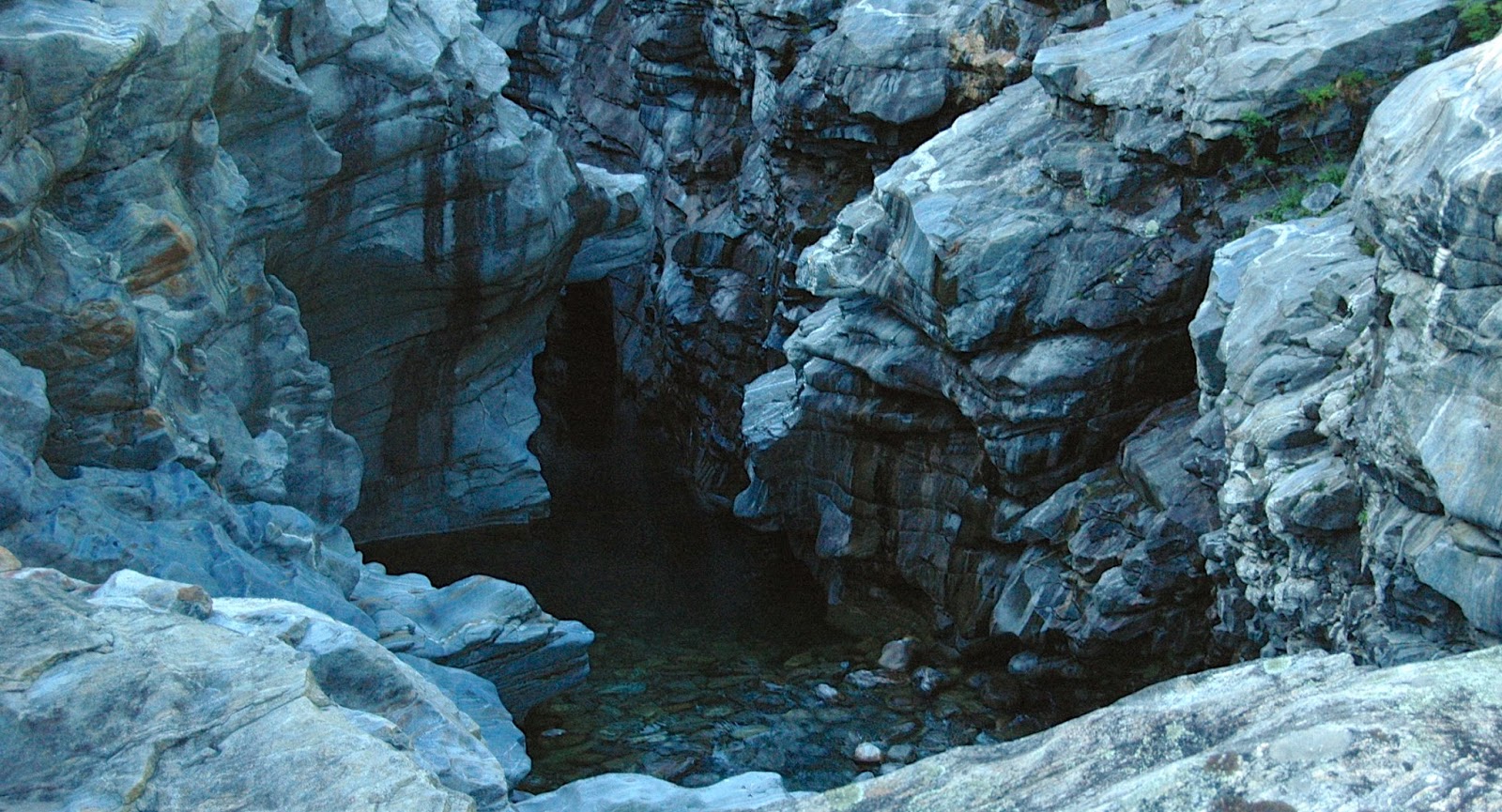
Rising some 70 feet above the silken-black water, the gorge’s ancient granite walls were washed as smooth as glacier ice into swirls and caverns and undulating forms.  We swam upstream for fifteen minutes, slipping through the chilly but not unpleasant, deliciously fresh water.   Above us towered these massive cliffs, soft and whitened from eons of raging floodwaters, sometimes coming so close together above us that it looked as if you could jump from one side to the other.


Ancient stone-wash
Just watch out for the dangers...

We ended our visit at the “grotte” or cave-restaurant where Johanna worked, where we had polenta, fresh cheese, lasagna, pesto, and ribs.  We invited everyone—Johanna, Caroline, Andrea, Thomas, and his son Jonathan, who was traveling around on Interrail at the time, to visit us in California.  We would love to reciprocate by sharing with them our little Sierra Nevada paradise! 


Typical Swiss valley


Tuesday, August 9, 2016

The French Countryside...and Dutch Cousins!

Still on a cousin kick, I could not resist the opportunity to visit my mother’s cousin Ole Langerhorst.  Ole is a Dutch sculptor, son of my German great Aunt Jule who married a Dutch man, Henni, after WWII.  Ole came to live with us for a year back in the 1980s to utilize the large amount of free wood in various family members’ back yards, so I already knew him and his wife Alize. 


Ole's woodworking tools

Ole and Alize had bought a farm deep in the French countryside.  We had been meaning to visit since we’d arrived in Europe, and this was our last chance.  So we made Ole’s farm near Vichy our first stop on a whirlwind last-round tour of Middle Europe. 

French countryside near Vichy

We landed in Frankfurt and drove right to Wiesbaden to see cousin/daughter Sophie, who had lived with us in Imperial Beach for a year right before we came to Spain.  Sophie took us to the Mainz Schwimmbad, and we had a great dinner with Paige and Hans, my aunt and uncle, along with Melinda, Hans’s sister (and my aunt) and my uncle Mohsen and cousin Elina.  Then off to France!

Welcome to the French countryside

We arrived in Vieure after a leisurely drive through Germany and France, arriving for dinner at the Dutch family reunion that had already been going on for a few days.  Ole in the meantime had switched from sculpting to farming, and has beautiful organic fields of vegetables—onions, garlic, kale, chard, lettuces of all sorts, tomatoes, zucchini, squash, and herbs—surrounding his modest farmhouse.  

Another view of Ole's workshop in context

Over 30 people had shown up for the reunion, and it was cousins galore!  I didn’t know I had cousins in Upper Austria, or in Portugal!  They’d all converged on Ole for this biennial reunion.  Most were children or related in some way to Jule and Henni, but some (us) were related to Jule’s sister Hilde, and some (Toeja and Wyck, who in the end couldn’t make it) were related to sister Gusse. 

Hurray for new cousins!!


The weather held, with only light rain at times, and we hiked to a beautiful tiny church on the hill behind the village.

Vieure's little church

A spectacular bed-and-breakfast next to the church

Making wishes with Alize

The next day went into picturesque Souveny for the medieval fair.  Tia and Sasha dressed up as fairytale princesses, and their third cousin Veronica could have been their sister!

With third-cousins Leah (center) and Veronica (left)

Medieval beauties

We played guitar and sang, with cousin Leah dancing up a storm.  My cousin Annette got out the sheet music for the German canon rounds they had learned from their mother as children, and I was astonished that I, too, knew some of them! 

That's a lot of cousins--and this is just the Jule branch of the family!
Our Dutch cousins in Souvigny

Three days was much too short, but we had reservations in Colmar, site of the Isenheimer Altar that I’d visited on a class field trip when I was  16, and I wanted to share it with Tia and Sasha.    

Tia takes it all in

Sasha liked the Ascension
 Colmar is an exquisite little town situated on the -__ river, its only drawback being its overwhelming success with tourists.  We stayed right in the Centre Vieure (old town) and walked to the Isenheimer Altar, gawking at the ancient crossbeamed fifteen-century houses still standing.

Colmar beauties

Beautiful houses in Strasbourg, too

Friend Arzu came down to visit overnight!

Strasbourg is right up the river from Colmar, so we took a day trip there to see the seat of the European Parliament and gaze upwards to the awe-inspiring carved red stone blocks of the Strasbourg Cathedral.  Even though I’ve now seen hundreds of gorgeous old churchs and cathedrals, I still marvel every time at the amazing human ingenuity that managed to construct such immense beauty without the aid of modern machines or technology. 

How did they build them so tall in medieval times???  Amazing


The European Parliament

France, land of beauty and good things to eat—we really spent far too little time here in our European adventure.  We shall return!

Sasha's idea of a perfect house


Sunday, July 31, 2016

Back to the Azores: We Found Cousins!!

Last summer, somewhat impetuously, I booked flights to the Azores on our way to Boston.  Since I had been cornered by my family to vacation someplace we could see my sisters (Tia and Sasha had a major hand in this effort!), I was determined to use this opportunity to visit our long-lost homeland, a goal talked about by my mom for years. (Click here for that blog.)

Our Portuguese homeland

The Azores are spectacular, and I fell in love with them.  I became determined to find any long-lost relatives that I was convinced must still exist in these verdant islands.  Suzi and Simone were willing to help find them AND meet us in the Azores to meet them!  After much searching, including hiring a private investigator on the island of Terceira, we found my great-grandfather’s sister’s great-granddaughter and great-grandson and made contact.  I wrote Facebook messages in Portuguese (cheating a lot with Google Translator) and arranged to visit.

This doesn't really help you learn the language, though...as I discovered!

Getting to the Azores from Puerto most cost-effectively entailed flying first to Barcelona, then on to Porto and finally into Ponta Delgada on São Miguel Island, all on RyanAir.  In Barcelona we spent an entire day devoted exclusively to Antonio Gaudi, visiting Sagrada Familia, La Pedrera as well as Casa Batlló on Passeig de Grácia, and ending the day at Parque Güell, all famous examples of Gaudi’s work.

Tia buys a selfie stick

We liked the inside better than the outside

Stopping through Porto on our way to the Azores, we met my third cousin, Ivo Machado.  A charming, stocky grey-haired-and-bearded air-traffic controller, he bought us coffee while we traced our family lineage, and he recommended his book, Nunca otros ojos, published in both Portuguese and Spanish.

Cousin Ivo
Here's the Amazon link to his book!


Once landed on São Miguel, we zipped over to Maria Resendes’s marvelous bed-and-breakfast, where I had sent Suzi and Ethan and the boys to stay, as they had landed two days earlier.  Maria prepared a true Azorean feast, sending Suzi and Ado to the calderas to bury the cozido in thermal pits, returning 5 hours later to pick up the cooked goods.  Later that night we watched a local soccer game between village teams—remarkably good for such a small place! 

Nossa Senhora de los Remedios, next to Maria's house
Maria and Dorotea, her helper.  Best hostess ever!  Makes you feel like she's your long-long aunt. 

Before we left the next morning, we hiked to an old sugar mill that Maria’s friend had just sold. It made me yearn to buy something similar and create my own little paradise.


The calderas:  Azoreans cook dinner here!

On our way to the west part of São Miguel, we stopped through Vila Franco de Campo to swim in the nearby caldera of an extinct volano, now a circular lagoon.

No sharks in this lagoon!

In Mosteiros, we lounged on black sand beaches, the kids playing pick-up soccer, and enjoyed several soaks in our favorite ocean thermal pools.  These pools were just as great as the first time we found them, hot towards the back, with gradients out towards the ocean until you found yourself in open and cool turquoise seas.

Tia shows her soccer moves

Thermal beauty

The tiny town of Mosteiros happened to have a town fair, and we hung out there before hopping our flight to a new island—Pico—and home of my great-grandmother, Tereza Pereira. 

Island beauty from our little cottages on Mosteiros's black sand beach

Simone and Chris met us in Pico at the lovely black-lava-stone houses of Adegas do Pico.  Pico is so named for the enormous volcanic cone that dominates its skyline.  It is sparsely inhabited, and the inland roads are lined with cows and hydrangea, while the coastal road weaves in and out of picturesque villages.  I swam each morning in cool silken waters off an exquisite black-sand beach.

The volcano dominates the island of Pico (pico=peak)

We celebrated my 53 birthday at a lovely fish restaurant in Magdalena, stopping first for a little wine tasting, then an unexpected find: a place to jump into clear water from a dock.  The kids loved it.

Into the abyss.  Lava pools like this are everywhere on these gorgeous islands

But the best for me was finding long-lost relatives.  On Pico it wasn’t easy; I had traced my great-grandmother’s family back to their ancestral home, but the trail went cold there.  “Just go there, you will find someone who knows something!”  said João, the investigator I’d been working with.  And so we did.  Walking down a tiny village road in São Cayetano, we began asking folks randomly for my great-grandmother’s house.   Fortunately for us, we met Paula, a Boston-based transplant from this very village who spoke perfect English.  “I don’t know, but I know someone who does!” she told us.  And so she introduced us to Clara and Anabela ,two novagenarians who had lived on that very street all their lives.  Clara suddenly turned to me.  “Manuel Rico?  Si!  Manuel Rico!” I was astonished and elated—this was my grandfather!  It turns out that they clearly remember his visit to the island in 1957, when he came to collect soil from his mother’s yard to bring back to her. Sadly, my great-grandmother Tereza died just days before he returned. 

They remember our grandfather's visit in 1957!

The  Portuguese, and in particular the Azoreans, are exceptionally warm and friendly.  Before we knew it, we were invited to the singing of the rosary in preparation for the festival that Saturday, and then to our new Bostonian friend’s sister’s birthday party.  All 8 of us stayed for cake and drinks before returning to our lava cottages. 

In-house altar

With Barbara, our long-lost relative?  She thought we were related through Tereza Pereira Rico 
Our final island was Terceira.  While Pico was lush, with cliffs and lava fields, Terceira was much more populated as well as agrarian, with many more houses and fields.  We stayed in a beach house owned by Azoreans now living in California, in San Jose, my home town.  The owners had created a darling Californian beach house on the cliffs of (name of town), complete with “This Way to the Beach” signs and American flags. 

Terceira's agricultural beauty

We swam from the rocks, avoiding the occasional jellyfish, and feasted on seafood and soupas, a dish we could remember from when my mom made it based on my Aunt Lolly’s recipe.  We went to an Azorean “bullfight,” more of a fun crazy celebration involving a bull on an enormous rope that runs around the village square while daring young people (almost always men) taunt the beast with cloaks and umbrellas. 

The Azorean bullfights are mostly funny and quite humane--no bull meat afterwards here!
No swords here, only umbrellas to tease the bulls with.  And a rope to keep the bull from stomping someone!
But the most wonderful and exciting experience by far in all of our Azorean travels was finding our third cousin, Filomena.   My great-grandfather, Manuel Rico, left the small village of Biscoitus on Terceira sometime in the latter part of the 19th century.  He married and had a boy, my grandfather Manuel, only to die (probably of appendicitis) 6 months later.  His sister, Ludovina, remained on Terceira and was Filomena’s great-grandmother.  

My great-great-aunt Ludovina, my great-grandfather Manuel's sister

Filomena’s mother, Maria João, is ailing and on oxygen, but she clearly remembered my grandfather’s visit to Terceira with my grandmother back in 1961.


My grandfather, Manuel Gonçalves Rico, circa 1954

“Can you come back for a snack after you swim?” Filomena asked us when all 8 of us descended on her to introduce ourselves.  So, after heading down to “The Abyss” for a swim in black-turquoise waters amid lava cliffs and coves, we climbed the stairs to her mother’s house.  

This is where we went swimming!  Amazing.


Inside was a feast fit for long-lost cousins, complete with several kinds of Azorean liqueurs and wines, home-made tuna tartar, local cheeses and bread, cucumbers and tomatoes from the garden, and the crowning dishes:  limpets from the sea….and soupas!!

Soupas, Azorean style like I remember it.

Limpets from the sea, a delicacy here

We chatted and laughed, everyone happy with our new-found relations.  Cousin Clara, Filomena’s aunt, came by to say hi and regaled us with stories she remembered as a 6-year-old awed by the American Manuel Rico’s visit.  Her memory was sharp and detailed, and she reminded me of  the vague impressions I still have left of my grandfather. 

The Rico sisters with Filomena and daughter Mariela

I could almost follow what she was telling me....

I left Terceira determined to return, and even better, determined to perfect my Portuguese!

All of us on our island of Terceira, home to the Ricos!


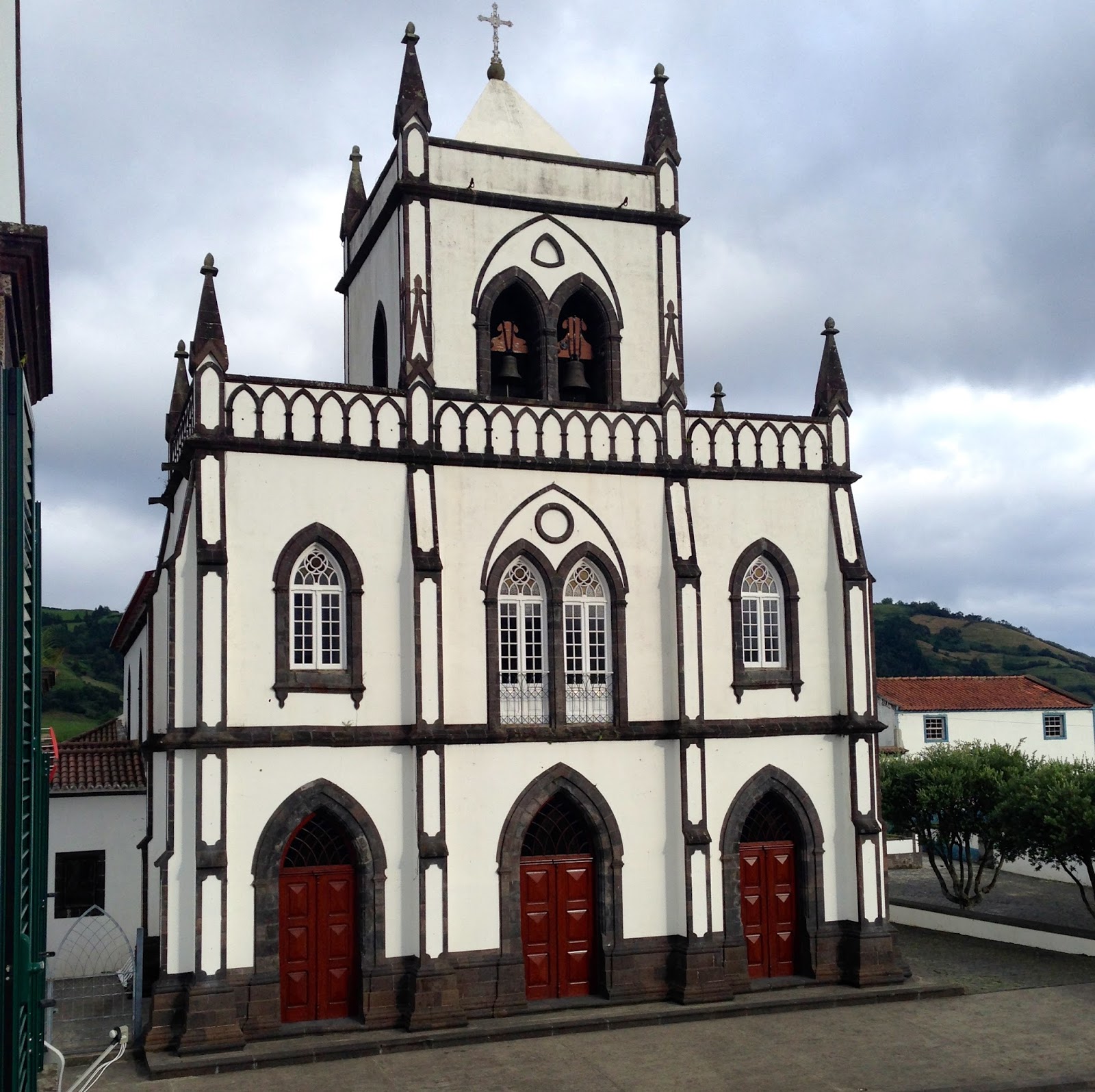
The Azorean black-and-white motif